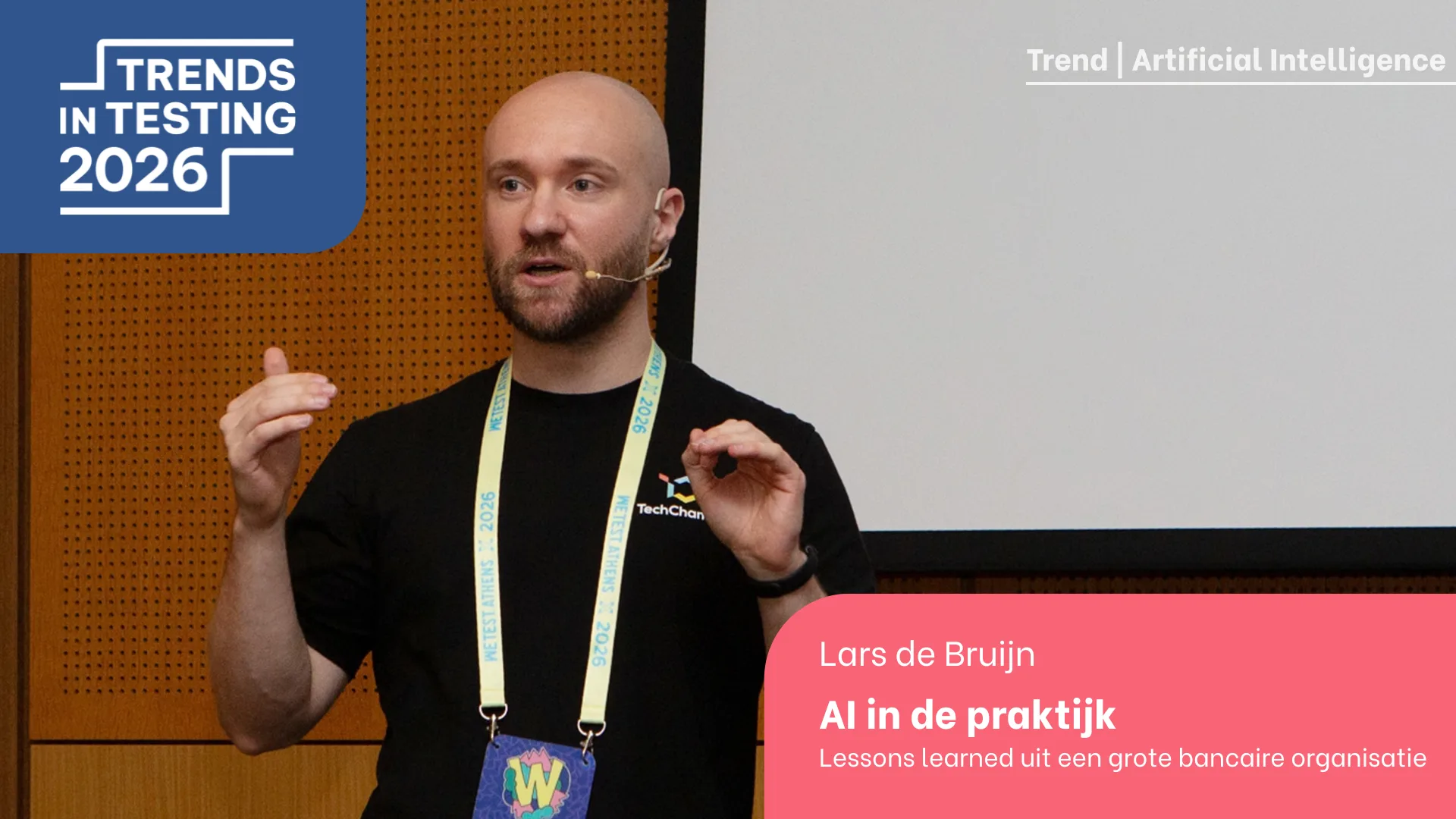
Wat gebeurt er als AI niet langer een experiment is, maar onderdeel wordt van het dagelijkse werk? Test automation engineer Lars de Bruijn ervaart het van dichtbij bij een grote bancaire organisatie, waar AI inmiddels breed wordt toegepast. Als enige tester in een team met negen developers ziet hij hoeveel snelheid en efficiëntie AI kan opleveren. Maar ook wat dat betekent voor vaardigheden, werkplezier en de rol van de tester. Een persoonlijke terugblik op de belangrijkste lessen uit de praktijk.
What happens when AI is no longer an experiment, but becomes part of everyday work? Test Automation Engineer Lars de Bruijn is experiencing this firsthand at a large banking organisation, where AI is now widely used. As the only tester in a team with nine developers, he sees just how much speed and efficiency AI can bring. But he also sees what this means for skills, job satisfaction and the role of the tester. A personal reflection on the most important lessons learned in practice.
From Experimentation to Everyday Practice
At the banking organisation where Lars works as a Test Automation Engineer, AI has become an integral part of daily development and testing activities. For Lars, this is particularly valuable: as the only tester in a team with seven developers, AI helps him keep up with the pace and prevents testing from becoming a bottleneck. In practice, he uses AI in five different ways.
1. Writing Automated Tests
Lars uses AI agents and chat functionalities to set up and develop automated test scripts more quickly. He determines the testing approach and the most important scenarios himself, while AI primarily supports the technical implementation in Playwright. This allows him to create more tests in less time.
2. Developing Proofs of Concept
AI also saves time when exploring new possibilities. Investigating new tools, understanding unfamiliar code and experimenting with solutions have become significantly faster. Sometimes, a usable proof of concept can be developed in just one day.
3. Developing a Test Automation Strategy
AI also acts as a sparring partner. When developing a new test automation strategy, Lars used AI to gather sources, structure information and combine insights from discussions. Partly thanks to AI, he was able to develop a complete strategy in approximately two weeks, which has since been implemented within the organisation.
4. Working with AI Agents and Skills
Lars increasingly works with agents, skills and complete AI workflows. These allow him to capture specific testing knowledge and make it available to others. This makes his expertise transferable and enables developers to continue working independently with these agents once his assignment comes to an end.
5. Creating Documentation
AI also speeds up the creation of technical and functional documentation. It analyses existing code and generates an initial draft, after which a colleague checks whether the explanation is accurate and easy to understand. A task that previously took an hour can now be completed in just a few minutes.
Organising AI Across the Bank
The use of AI is not limited to individual employees and teams. The bank is also investing in knowledge sharing, reusable solutions and responsible AI adoption across the organisation.
For example, employees share new developments, demonstrations and practical experiences during weekly sessions within an internal AI community. There is also a central repository containing AI agents and skills that teams can reuse. In addition, AI is being integrated into automated pipelines to perform checks that previously required manual effort.
Among developers, AI is also becoming an increasingly important part of their workflows. Tasks that were previously estimated to require substantial effort can sometimes be completed much faster. This not only changes the work itself, but also affects how teams plan and estimate capacity.
Technology Is Moving Faster Than the Organisation
The opportunities are significant, but putting AI into practice also comes with challenges. Particularly within a banking organisation, compliance, regulations and internal processes play an important role. Not everything that is technically possible is necessarily permitted.
Furthermore, technological development sometimes moves faster than cultural change. Some employees embrace AI, while others remain hesitant or worry about what it means for their jobs. According to Lars, it is important to take these concerns seriously.
Small, visible successes can help. A proof of concept demonstrating that a task can suddenly be completed in a fraction of the time makes the value of AI tangible.
At the same time, clear guidelines are essential. Which tools are employees allowed to use? What data can they share? And how should they responsibly manage aspects such as costs and token consumption?
A well-defined AI policy therefore does more than reduce risks. It also gives employees the confidence and freedom to experiment safely.
How Is AI Changing the Role of the Tester?
Perhaps the most interesting change Lars has noticed is in his own work. Previously, he wrote much of the code himself. Today, he largely leaves that to AI.
He knows what needs to be done, can give AI clear instructions and is able to assess the generated code. However, after using AI extensively, writing the same code from scratch no longer comes as naturally as it once did.
At the same time, other skills are becoming increasingly important. Understanding the bigger picture, identifying connections, providing the right context and critically evaluating whether a solution actually works: the focus is shifting from carrying out tasks yourself to directing and assessing the work.
This requires testers to have a solid foundation in both testing and technology. After all, you can only determine whether AI has delivered a good solution if you understand what a good solution should look like.
Skills such as critical thinking, asking the right questions, providing context and identifying risks are also becoming more important.
This development also affects team composition. At the beginning of his assignment, it was almost impossible for Lars to keep up with nine developers as the only tester. Thanks to AI, that workload has become much more manageable. Meanwhile, developers are increasingly learning to use AI for testing activities themselves.
This does not mean that the role of the tester will disappear, but it is certainly changing.
It is becoming more important to oversee quality across the entire development process, help developers make informed testing decisions and critically assess where AI can and cannot be used responsibly.
Alongside technical expertise, skills such as advising, communication, knowledge transfer and collaboration are therefore becoming increasingly valuable.
The Downside of Efficiency
Greater speed and productivity sound entirely positive. However, Lars also sees a less obvious consequence: AI can take some of the challenge out of work.
For professionals who enjoy solving complex technical problems themselves, it can take some getting used to when AI takes over much of that work.
Others appreciate spending less time on execution and being able to focus more on analysis and problem-solving.
This creates a new challenge for managers.
If AI increasingly takes over operational tasks, how do you ensure that employees continue to experience sufficient challenge, professional development and job satisfaction?
The impact of AI should therefore not only be measured in terms of time savings and productivity, but also in terms of how it affects people and their work.
Looking Beyond the Technology
The experience at this banking organisation demonstrates how quickly AI can transform everyday work.
With the help of AI, a single tester can support a team of nine developers. Tasks that previously took hours or days can be completed much faster, and knowledge can be made available to entire teams through agents and skills.
But perhaps the most important change is not what AI itself can do.
AI is also changing the skills professionals need, how teams are structured and where people find satisfaction and challenge in their work.
As a result, the most important question for organisations is increasingly no longer whether they should use AI.
A far more interesting question is how they can ensure that technology, organisations and people continue to develop together.
Three Lessons Learned in Practice
After working extensively with AI, these are the three most important lessons Lars would like to share.
1. Provide Context and Keep Thinking for Yourself
AI has access to an enormous amount of knowledge, but it does not automatically understand your organisation, your situation or your experience.
The quality of its output therefore largely depends on the context you provide.
Be specific, apply your own professional expertise and continue to critically evaluate the results.
Delegate the work, but never your judgement.
2. Demonstrate the Time Savings, Not the Technology
Want to convince others of the value of AI? Focus on making the benefits tangible.
Rather than explaining how advanced the technology is, demonstrate how much time, capacity or money it can save.
Reducing a task from two hours of manual work to just ten minutes is often far more convincing than a technical explanation of the solution.
3. Look Beyond Efficiency Alone
Greater speed and productivity are valuable, but AI also affects how people experience their work.
If AI takes over precisely the tasks that give someone a sense of challenge, enjoyment or professional growth, increased efficiency can also have a downside.
Therefore, do not focus solely on what AI delivers for the organisation. Keep talking to employees about how it affects their profession, development and job satisfaction.
The best use of AI not only makes work more efficient, but also ensures that people can continue to grow and develop.